
History
Max Richter: A Post-Minimalist Composer Bridging Classical and Contemporary Soundscapes
Max Richter, born March 22, 1966, in Hamelin, Germany, is a prominent German-born British composer recognized for his significant contributions to post-minimalist music. Since the early 2000s, he has carved a unique niche by harmonizing contemporary classical music with alternative popular styles. Richter's formal training in composition at the Royal Academy of Music and his tutelage under Luciano Berio in Italy laid a strong foundation for his diverse career.
A Prolific and Versatile Artist
Richter's output is characterized by its breadth and depth. He composes and records his own music, creates scores for stage, opera, ballet, and screen, produces and collaborates on other artists' records, and engages with performance, installation, and media artists. He has released seven solo albums, and his distinctive musical style has found widespread application in cinema.
Early Life and Musical Foundations
Growing up in Bedford, United Kingdom, Richter's early education took place at Bedford Modern School and Mander College of Further Education. His musical studies continued at the University of Edinburgh and the Royal Academy of Music, culminating in studies with Luciano Berio in Florence. Following his academic pursuits, Richter co-founded the contemporary classical ensemble Piano Circus. During his ten years with the group, he commissioned and performed works by influential minimalist composers such as Arvo Pärt, Brian Eno, Philip Glass, Julia Wolfe, and Steve Reich. The ensemble released five albums under the Decca/Argo label.
Collaborations and Genre Exploration
Richter's career has been marked by notable collaborations across various musical genres. In 1996, he worked with The Future Sound of London on their album Dead Cities, contributing as a pianist and co-writing the track "Max." His involvement with the group extended to their albums The Isness and The Peppermint Tree and Seeds of Superconsciousness. In 2000, he collaborated with Roni Size on the Reprazent album In the Møde. Richter also produced Vashti Bunyan's 2005 album Lookaftering and Kelli Ali's 2008 album Rocking Horse.
Soundtracks and Cinematic Impact
Max Richter has composed numerous scores for film and television. His work on Ari Folman's 2007 Golden Globe-winning film Waltz with Bashir, which favored synth-based sounds over traditional orchestral arrangements, earned him the European Film Award for Best Composer. He also scored the independent feature film Henry May Long (2008) and Feo Aladag's film Die Fremde.
His piece "On the Nature of Daylight" gained significant recognition when it was remixed with Dinah Washington's "This Bitter Earth" for Martin Scorsese's 2010 film Shutter Island. The track, along with "Vladimir's Blues," was featured prominently in the 2010 BBC Two drama Dive. "On the Nature of Daylight" also appeared in an episode of HBO's Luck. Four of his tracks—"Europe, After the Rain," "The Twins (Prague)," "Fragment," and "Embers"—were used in the 2005 BBC documentary series Auschwitz: The Nazis and the Final Solution. Richter also composed the soundtrack for the documentary How to Die in Oregon and the score for André Téchiné's 2011 film Impardonnables.
Excerpts from his 2002 album Memoryhouse, specifically "Sarajevo," were featured in the international trailer for Ridley Scott's Prometheus. The track "November" from the same album was used in the trailer for Terrence Malick's To the Wonder (2012) and Clint Eastwood's J. Edgar (2011). His music also featured in the 2011 films Elle s'appelait Sarah and Perfect Sense. In 2012, he composed the scores for Cate Shortland's war thriller Lore and Henry Alex Rubin's Disconnect. His latest film project at the time of this writing was the score for Ari Folman's 2013 film The Congress.
Richter is also the composer of the original soundtrack for the HBO series The Leftovers, created by Damon Lindelof and Tom Perrotta, which premiered in June 2014. Some of these compositions are drawn from his albums Memoryhouse and The Blue Notebooks.
In 2016, Richter composed the score for "Nosedive," an episode of Charlie Brooker's Black Mirror. His piece "On the Nature of Daylight" bookends Denis Villeneuve's acclaimed film Arrival. He also wrote the scores for Luke Scott's debut feature Morgan and Miss Sloane. Furthermore, he composed all the music for the BBC One drama Taboo, broadcast in early 2017.
Interdisciplinary Collaborations
Beyond film and television, Richter has engaged in significant collaborations with dance and theatre. He composed the score for Infra, a Royal Ballet commission in collaboration with dancer Wayne McGregor and artist Julian Opie, which premiered at the Royal Opera House in 2008. In 2011, Richter created a chamber opera based on neuroscientist David Eagleman's book Sum: Forty Tales from the Afterlives. Choreographed by Wayne McGregor, the opera premiered at the Royal Opera House Linbury Studio Theatre in 2012 to positive reviews.
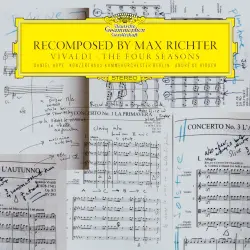
Their creative partnership continued with Wayne McGregor's 'Kairos' in April 2014, a ballet set to Richter's recomposition of Vivaldi's The Four Seasons, as part of a larger program titled 'Notations' with Ballett Zürich. It was also announced in April 2014 that Richter and McGregor would collaborate on a new full-length ballet for the 2014-15 Royal Opera House season. Between 2012 and 2013, Richter contributed music to The National Theatre of Scotland's production of Macbeth, starring Alan Cumming, which opened at New York's Lincoln Centre before moving to Broadway. The company had previously utilized Richter's piece "Last Days" in their acclaimed production of Black Watch.
In 2010, Richter's soundscape The Anthropocene was featured in Darren Almond's film installation at the White Cube gallery in London. He has also collaborated with the digital art collective Random International on two projects, providing scores for their installations Future Self (2012) at MADE in Berlin, and Rain Room (2012/13) at London's Barbican Centre and New York's MoMA.
Discography