
History
Carl Maria von Weber: A Pioneer of German Romantic Opera
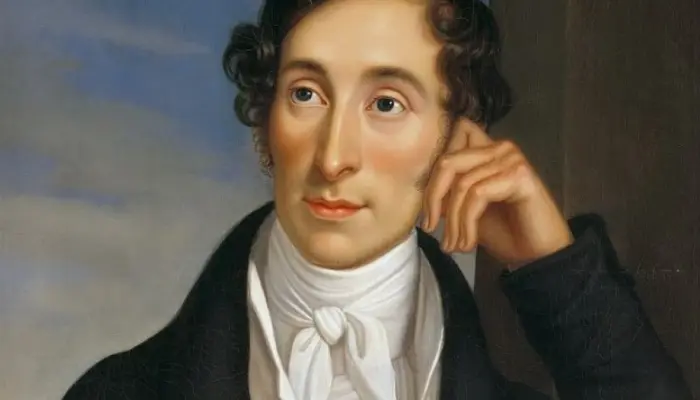
Carl Maria Friedrich Ernst von Weber (November 18, 1786 – June 5, 1826) was a German composer, conductor, pianist, and critic. He is recognized as one of the earliest and most significant composers of the Romantic era, profoundly shaping the development of German opera and influencing instrumental music.
Operatic Innovations and Instrumental Mastery
Weber's operas, particularly Der Freischütz, Euryanthe, and Oberon, established a new standard for German Romantic opera. His innovative approach extended to instrumental music, with his compositions for the clarinet—including two concertos, a concertino, a quintet, and a duo concertante—remaining staples of the repertoire. His piano works, such as the four sonatas, two concertos, and the renowned Konzertstück in F minor, served as inspiration for later composers like Frédéric Chopin, Franz Liszt, and Felix Mendelssohn. Liszt frequently performed the Konzertstück, and Igor Stravinsky acknowledged it as a model for his own Capriccio for piano and orchestra.
Contributions to Vocal and Choral Music
Beyond opera, Weber made significant contributions to vocal and choral music. His Catholic religious works were highly regarded in 19th-century Germany. He also composed one of the earliest song cycles, Die Temperamente beim Verluste der Geliebten.
Orchestration and Lasting Influence
Weber's masterful orchestration was lauded and emulated by subsequent generations. Hector Berlioz referenced his techniques in his Treatise on Orchestration, while Claude Debussy noted Weber's ability to capture the "soul of each instrument." His operatic influence was particularly strong among German composers like Heinrich Marschner, Giacomo Meyerbeer, and Richard Wagner, as well as nationalist composers such as Mikhail Glinka. Twentieth-century composers, including Debussy, Stravinsky, Gustav Mahler (who completed Weber's unfinished opera Die drei Pintos and revised Euryanthe and Oberon), and Paul Hindemith (composer of Symphonic Metamorphoses on Themes of Weber), paid homage to his work.
Early Life and Education
Born into a musical family, Weber's father, Franz Anton von Weber, was a military officer and later a musical director. Weber's early musical education was extensive but frequently interrupted by the family's travels. He studied with the oboist Johann Peter Heuschkel in Hildesheim and later with Michael Haydn in Salzburg and Johann Evangelist Wallishauser and J.N. Kalcher in Munich. His first published work, six fughettas for piano, appeared in 1798. His early opera, Die Macht der Liebe und des Weins, is now lost.
Developing Career and Personal Challenges
In 1800, Weber composed his opera Das stumme Waldmädchen, which was later performed in several major European cities. He also began his career as a music critic. Further studies with Abbé Vogler in Vienna led to his opera Peter Schmoll und seine Nachbarn being produced in 1803, marking his first popular success. Vogler's recommendation secured Weber the position of Director at the Opera in Breslau in 1806. His subsequent tenure at the court of the Duke of Württemberg in Stuttgart (1807–1810) was marked by personal difficulties, including financial troubles and expulsion from Württemberg. Despite these challenges, he continued to compose, particularly religious music.
Establishing German Opera and Major Works
Weber's career advanced through opera directorships in Prague (1813–1816) and Berlin (1816–1817). From 1817, he dedicated himself to establishing a German national opera in Dresden, in contrast to the dominance of Italian opera. The premiere of Der Freischütz in Berlin on June 18, 1821, was a triumphant success, leading to widespread European performances and securing its place in the repertoire. The opera's popularity stems from its colorful harmonies, folk-inspired themes, and dramatic, supernatural narrative.
In 1823, Weber composed Euryanthe, followed by Oberon in 1824, commissioned by Covent Garden in London. He traveled to England to oversee the premiere of Oberon on April 12, 1826.
Final Years and Legacy
Weber's other notable works include Invitation to the Dance (later orchestrated by Berlioz), the Polacca Brillante, two symphonies, clarinet concertos and concertino, a clarinet quintet, and a horn concertino. Suffering from tuberculosis, Weber died in London on June 5, 1826. His remains were later exhumed and reburied in Dresden in 1844, an initiative led by Richard Wagner.
Discography